Wednesday, 17 August 2011

Forex Strategy Outlook: US Dollar Volatility Favors Breakout Trading


Exchange rate volatility expectations suggest that the US Dollar and Swiss Franc could see significant swings in the week ahead, favoring volatility-friendly breakout strategies and warning against range trading techniques.

DailyFX Individual Currency Pair Conditions and Trading Strategy Bias
Forex_Strategy_dollar_volatility_body_Picture_1.png, Forex Strategy Outlook: US Dollar Volatility Favors Breakout Trading

DailyFX+ System Trading Signals –Impressive currency swings have made Breakout2 a strong outperformer through the past seven days—especially on Swiss Franc and Japanese Yen pairs. The surprisingly range-bound EURUSD presented a challenge for price and sentiment strategies. Yet Range1and Range2 did poorly across the board, and such high volatility expectations advise caution against trading strategies susceptible to losses on strong price swings.

Our outlook for Momentum1 and Momentum2 is slightly more nuanced. Both strategies thrive during times of strong trends and do poorly in choppy trading conditions. It will be critical to watch whether currencies break key ranges in the days ahead.

Forex_Strategy_dollar_volatility_body_Picture_2.png, Forex Strategy Outlook: US Dollar Volatility Favors Breakout Trading
To gain a greater understanding of all six trading systems, view my recent presentation on SSI and the trading signals on our FXCM Digital Expo page.

As we pointed out last week, our volatility expectation indices have broken their trends of lower highs dating back to the financial crisis. And though 1-week, 1-month, and 3-month expectations are off of their most recent highs, it seems we are entering a period of higher volatility across the board.

Such trends warn against trading range trading strategies, which are especially susceptible to losses on strong exchange rate swings.

Forex_Strategy_dollar_volatility_body_Picture_3.png, Forex Strategy Outlook: US Dollar Volatility Favors Breakout Trading
Written by David Rodríguez, Quantitative Strategist for DailyFX.com, drodriguez@dailyfx.com

To be added to this author’s distribution list, send an e-mail subject line “Distribution list” to drodriguez@dailyfx.com

Definitions
Range Strategy – The benchmark range trading system shows the hypothetical performance of a simple Relative Strength Index strategy on 60-minute EURUSD, GBPUSD, USDJPY, USDCHF, USDCAD, AUDUSD, and NZDUSD pairs. It sells when the 14-period RSI falls below 70 and buys when it crosses above 30. No other trading rules are used. Hypothetical results are generated using FXCM Strategy Trader.
Trend Strategy – The benchmark trend trading system shows the hypothetical performance of a simple Moving Average Crossover strategy on 60-minute EURUSD, GBPUSD, USDJPY, USDCHF, USDCAD, AUDUSD, and NZDUSD pairs. It buys the currency pair when the 50-period Simple Moving Average crosses above the 100-period and 200-period averages. It sells when the 50-period crosses below the 100-period and 200-period averages. No other trading rules are used.
Breakout Strategy – The benchmark breakout trading system shows the hypothetical performance of a simple Channel Breakout strategy on 60-minute EURUSD, GBPUSD, USDJPY, USDCHF, USDCAD, AUDUSD, and NZDUSD pairs. It will set a buy order at the highest high of the previous 20 bars plus one pip and a sell order at the lowest low of the previous 20 bars minus one pip. No other trading rules are used.
Volatility Percentile – The higher the number, the more likely we are to see strong movements in price. This number tells us where current implied volatility levels stand in relation to the past 90 days of trading. We have found that implied volatilities tend to remain very high or very low for extended periods of time. As such, it is helpful to know where the current implied volatility level stands in relation to its medium-term range.
Trend – This indicator measures trend intensity by telling us where price stands in relation to its 90 trading-day range. A very low number tells us that price is currently at or near monthly lows, while a higher number tells us that we are near the highs. A value at or near 50 percent tells us that we are at the middle of the currency pair’s monthly range.
Range High – 90-day closing high.
Range Low – 90-day closing low.
Last – Current market price.
Bias – Based on the above criteria, we assign the more likely profitable strategy for any given currency pair. A highly volatile currency pair (Volatility Percentile very high) suggests that we should look to use Breakout strategies. More moderate volatility levels and strong Trend values make Momentum trades more attractive, while the lowest Vol Percentile and Trend indicator figures make Range Trading the more attractive strategy.
HYPOTHETICAL PERFORMANCE RESULTS HAVE MANY INHERENT LIMITATIONS, SOME OF WHICH ARE DESCRIBED BELOW. NO REPRESENTATION IS BEING MADE THAT ANY ACCOUNT WILL OR IS LIKELY TO ACHIEVE PROFITS OR LOSSES SIMILAR TO THOSE SHOWN. IN FACT, THERE ARE FREQUENTLY SHARP DIFFERENCES BETWEEN HYPOTHETICAL PERFORMANCE RESULTS AND THE ACTUAL RESULTS SUBSEQUENTLY ACHIEVED BY ANY PARTICULAR TRADING PROGRAM.
ONE OF THE LIMITATIONS OF HYPOTHETICAL PERFORMANCE RESULTS IS THAT THEY ARE GENERALLY PREPARED WITH THE BENEFIT OF HINDSIGHT. IN ADDITION, HYPOTHETICAL TRADING DOES NOT INVOLVE FINANCIAL RISK, AND NO HYPOTHETICAL TRADING RECORD CAN COMPLETELY ACCOUNT FOR THE IMPACT OF FINANCIAL RISK IN ACTUAL TRADING. FOR EXAMPLE, THE ABILITY TO WITHSTAND LOSSES OR TO ADHERE TO A PARTICULAR TRADING PROGRAM IN SPITE OF TRADING LOSSES IS MATERIAL POINTS WHICH CAN ALSO ADVERSELY AFFECT ACTUAL TRADING RESULTS. THERE ARE NUMEROUS OTHER FACTORS RELATED TO THE MARKETS IN GENERAL OR TO THE IMPLEMENTATION.
OF ANY SPECIFIC TRADING PROGRAM WHICH CANNOT BE FULLY ACCOUNTED FOR IN THE PREPARATION OF HYPOTHETICAL PERFORMANCE RESULTS AND ALL OF WHICH CAN ADVERSELY AFFECT ACTUAL TRADING RESULTS. Any opinions, news, research, analyses, prices, or other information contained on this website is provided as general market commentary, and does not constitute investment advice. The FXCM group will not accept liability for any loss or damage, including without limitation to, any loss of profit, which may arise directly or indirectly from use of or reliance contained in the trading signals, or in any accompanying chart analyses.

US Dollar to Rise Anew as Stock Market Recovery Losses Steam


Major Currencies vs. US Dollar (% change)
08 Aug 2011 – 16 Aug 2011

US_Dollar_to_Rise_Anew_as_Stock_Market_Recovery_Losses_Steam_body_Picture_5.png, US Dollar to Rise Anew as Stock Market Recovery Losses Steam


Talking Points

  • EUR: Renewed Selling Likely as Merkel, Sarkozy Dither on EFSF
  • GBP: Bank of England Minutes Confirm Dovish Shift on MPC
  • JPY: Yen Still Caught Between Risk Trends, Intervention Threat
  • CAD, AUD, NZD: Stock Markets Continue to Dictate Direction

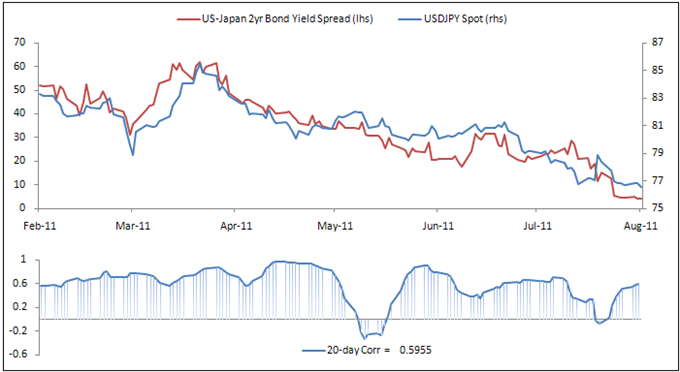
Currency markets remain firmly anchored to broad-based risk sentiment trends, with most major currencies mirroring investors’ expectations for the evolution of the global economic recovery as reflected in benchmark stock indexes. The Yen is an exception, but here too risk appetite is the key consideration, although its impact is transmitted through a link to Treasury bond yields rather than a direct correlation with share prices (i.e. risk aversion boosts the Yen as capital flows out of equities and into government debt, pushing yields lower and vice versa).

Sizing up the landscape, the recovery in confidence that began at the start of the week appears to be fizzling out as one-off event risks including the Merkel/Sarkozy summit and Switzerland’s rumored announcement of a EURCHF peg pass with little fanfare, leaving little in their wake except the now familiar reality of slowing global growth. New evidence has continued to emerge after the US Empire manufacturing gauge and German GDP figures disappointed while the hawks at the Bank of England abandoned their positions amid increasingly dour conditions. Much was made of a better-than-expected Japanese GDP report, but the nominally smaller drop in output than predicted by economists but the outcome still amounted to the second consecutive print in negative territory, confirming a technical recession the world’s third-largest economy.

Looking ahead, the spotlight falls on the Philadelphia Fed Business Confidence gauge, with expectations calling for another drop in August after a shallow bounce in the previous month. US Consumer Price Index figures will also enter the picture, with headline inflation expected to drop for the first time in seven months. With that in mind, some moderation here was to be expected as oil prices pulled back along with the diminishing outlook for global demand at large. As such the Core CPI figure excluding volatile items (such as energy prices) ought to prove more interesting. This metric is forecast to rise to the highest since November 2009, reinforcing the status quo in the outlook for Federal Reserve monetary policy and keeping a lid on QE3 hopes.

On balance, this opens the door for renewed risk aversion, clearing the way for losses in stocks-correlated currencies against the safe-haven US Dollar. In fact, the greenback ought to begin benefitting disproportionately from safety-bound flows as the only currency not facing the threat of official intervention, as is the case with the Japanese Yen and the Swiss Franc. With that said, speculative short positioning in S&P 500 index futures – a proxy for risk appetite at large – hit the highest level in five months last week, so a deeper upward correction in risky assets is not out of the question in the near term until sellers return in force.


EUR/USD

US_Dollar_to_Rise_Anew_as_Stock_Market_Recovery_Losses_Steam_body_Picture_6.png, US Dollar to Rise Anew as Stock Market Recovery Losses Steam


Key Upcoming Events

DAYGMTEVENTEXPPREVIMPACT
19 AUG6:00German Producer Prices (MoM) (JUL)0.1%0.1%Medium
19 AUG6:00German Producer Prices (YoY) (JUL)5.3%5.6%Medium


GBP/USD

US_Dollar_to_Rise_Anew_as_Stock_Market_Recovery_Losses_Steam_body_Picture_7.png, US Dollar to Rise Anew as Stock Market Recovery Losses Steam


Key Upcoming Events

DAYGMTEVENTEXPPREVIMPACT
18 AUG8:30Retail Sales ex Auto Fuel (YoY) (JUL)0.1%0.2%Medium
18 AUG8:30Retail Sales ex Auto Fuel (MoM) (JUL)0.4%0.8%Medium


USD/JPY

US_Dollar_to_Rise_Anew_as_Stock_Market_Recovery_Losses_Steam_body_Picture_8.png, US Dollar to Rise Anew as Stock Market Recovery Losses Steam


Key Upcoming Events

DAYGMTEVENTEXPPREVIMPACT
  None   


USD/CAD

US_Dollar_to_Rise_Anew_as_Stock_Market_Recovery_Losses_Steam_body_Picture_9.png, US Dollar to Rise Anew as Stock Market Recovery Losses Steam


Key Upcoming Events

DAYGMTEVENTEXPPREVIMPACT
19 AUG11:00Consumer Price Index (YoY) (JUL)2.8%3.1%High
19 AUG11:00Consumer Price Index (MoM) (JUL)0.2%-0.7%Medium


AUD/USD

US_Dollar_to_Rise_Anew_as_Stock_Market_Recovery_Losses_Steam_body_Picture_10.png, US Dollar to Rise Anew as Stock Market Recovery Losses Steam


Key Upcoming Events

DAYGMT EXPPREVIMPACT
  None   


NZD/USD

US_Dollar_to_Rise_Anew_as_Stock_Market_Recovery_Losses_Steam_body_Picture_11.png, US Dollar to Rise Anew as Stock Market Recovery Losses Steam

All Talk, No Action From SNB


Earlier this morning, the markets were left somewhat disappointed in the lack of action taken by the Swiss National Bank (SNB) with regard to how they are going to manage their currency.  Recent statements about a possible peg to the Euro or the setting of a target rate for the franc went unfulfilled as the franc has bounced off of the lows just above parity with the Euro.
This illustrates how a Central bank can influence its currency through the threat (or promise) of certain action, though the market may attempt to test that Ceentral bank’s resolve.  What the Swiss did say though is that they would be adding liquidity to the market, which esentially means that they will be active and could embark on a series of “mini-interventions”  if they are not happy with the value of the franc (CHF).
So the Swissie strengthened immediately on the non-action, though it has weakened a bit as the market has started the morning in risk-taking mode with less demand for safe havens.  So the franc appears to be trading in a range between its S1 pivot support and R1 pivot resistance.


eurchf0817

All Talk, No Action From SNB

U.S. Commodities Day Ahead: Gold and Wheat Climb, Rubber Drops


ECONOMIC EVENTS, AGRICULTURE REPORTS:
                                       Forecast  Prior      Time
                                                          (N.Y.)

MBA Mortgage Applications    AUG 12               21.7%     7:00
U.S. Producer Price Index (MoM)  JUL    0.1%      -0.4%     8:30
U.S. PPI Ex Food & Energy (MoM)  JUL    0.2%      0.3%      8:30
U.S. Producer Price Index (YoY)  JUL    7.0%      7.0%      8:30
U.S. PPI Ex Food & Energy (YoY)  JUL    2.3%      2.4%      8:30
USDA Cattle Slaughter         AUG 17              128000   14:00
USDA Hog Slaughter            AUG 17              413000   14:00
USDA Broiler Eggs Set         AUG 12              196033   15:00

Metal Prices: ($/ton)
                 Last  % Chg RSI
Copper          8,891   +0.7  38
Aluminum        2,373   -0.1  32
Zinc            2,194   +0.5  39
Lead            2,368   +0.5  39
Nickel         21,725   +0.1  39
Tin            24,425   +1.1  41

Other Markets:
                       Last  % Chg % YTD
U.S. Dollar Index    73.747   -0.3  -6.7
Crude Oil            $87.67   +1.2  -4.1
Gold               $1,791.4   +0.3   +26
MSCI World Index   1,197.59   +0.1  -6.4
COMMODITY EXCLUSIVES:
Norway’s Oil Era Extended as North Sea Offers Hidden Giant (1)
Norway may slow a decade-long slump in oil production after a series of discoveries from the Arctic to the North Sea.
Fertilizers Lag Food Costs in Boost to Global Production Outlook
Prices in the $150 billion fertilizer market are lagging behind gains in food costs, providing farmers another incentive to boost production as grains and oilseeds advance.
INDUSTRIAL METALS:
Copper May Rise as Gap in Prices Spurs Purchasing From China
Copper may rise in London on signs Chinese buyers are taking advantage of the gap between prices in the U.K. city and Shanghai.
South Korean Agency Buys Aluminum, Zinc, Nickel in Tenders (1)
South Korea, Asia’s third-biggest buyer of base metals, bought 2,000 metric tons of aluminum, 1,500 tons of zinc and 200 tons of nickel in tenders, according to a government body website.
MINING:
Talvivaara Shares Slump on Quarterly Loss, Guidance Reassessment
Talvivaara Mining Co., a Finnish nickel producer, fell the most in more than a week in London trading after reporting a second-quarter loss.
ENRC First-Half Profit Rises 29% on Higher Commodity Prices (1)
Eurasian Natural Resources Corp., a Kazakh metals producer, posted a 29 percent increase in first-half profit and said a review of corporate governance is “well under way.”
Bumi Posts $62 Million Operating Profit on Record Coal Price (1)
Bumi Plc, the Indonesian coal exporter founded by Nathaniel Rothschild last year, reported operating profit of $62 million in the first half, driven by record thermal-coal prices.
PRECIOUS METALS:
Gold Gains for Third Day in London as Debt Concerns Spur Demand
Gold climbed for a third day in London and approached a record as concern about Europe’s debt crisis spurred demand for a protection of wealth.
Gold May Decline $100 After Gain of $900 Since End of 2008 (1)
Gold, which has risen about $900 since the end of 2008, may fall by $100 an ounce or more in the “near term” and probably still attract buyers, UBS AG said.
Palladium Rebound to Halt Near $779 an Ounce: Technical Analysis
Palladium’s rebound from a 12-week low last week may halt near $779 an ounce, according to technical analysis by Commerzbank AG.
U.S. Gained From Ending Gold Standard in 1971: Chart of the Day
The U.S. “benefitted immeasurably” from dropping the gold standard four decades ago because the dollar became the world’s reserve currency, allowing borrowing costs to fall, Societe Generale SA said.
Gold Market Is a ‘Bubble Poised to Burst,’ Wells Fargo Says (3)
Speculative demand from investors has pushed the gold market into a “bubble that is poised to burst” after prices surged to a record this year, Wells Fargo & Co. said.
AGRICULTURE:
Peppers Wilt as Barley Drowns for Farmers Who Can’t Tap Tax Aid
Sunburn is hard to avoid in the heat of a southeast Texas summer. Even the watermelons have it this year.
Wheat Rises for Third Day as Dryness May Reduce U.S. Seeding
Wheat rose for a third day in Chicago on speculation hot, dry weather in the U.S. Plains may curb seeding of winter varieties and on concern adverse weather in Russia and Ukraine might hurt crops.
Coffee Rises as Vietnam Harvest Nears Completion; Cocoa Drops
Coffee rose for a seventh session in London on concern about limited supplies from Vietnam as the harvest in the world’s largest producer of robusta beans neared completion. Cocoa fell.
Sugar Exports From India to Climb on Higher Output, Group Says
Sugar exports from India, the second-largest producer, may climb as much as 54 percent next year as output expands for a third year and a supply shortage from Brazil drives demand, according to a producers’ group.
Rubber Drops for Second Day as European Crisis May Hurt Demand
Rubber dropped for a second day on mounting concern that Europe’s debt crisis may worsen, hurting the global economy and demand for the commodity used in tires and gloves.
Japan Buys 14,750 Tons of Feed Wheat in Tender, Ministry Says
Japan bought 14,750 metric tons of feed wheat in a tender today, the Ministry of Agriculture, Forestry and Fisheries said.
Asia Inflation Risk to Rise on Thai Plan to Boost Rice Price (2)
Yingluck Shinawatra became Thailand’s first female prime minister by pledging to lift rural incomes through higher rice prices. The rest of Asia may now have to pay for her campaign promise.
Soybean Output in India May Climb as Monsoon Rains Spur Sowing
Soybean production in India, Asia’s biggest exporter of the oilseed meal, may climb as much as 10 percent next year as farmers increase area under the oilseed, a processors’ group said.
SHIPPING:
Maersk’s Tanker Subsidiary Extends Losses Into a Third Year
Maersk Tankers, a division of A.P. Moeller-Maersk A/S and operator of the world’s largest product tanker fleet, lost $19 million in the first half, extending losses into a third year.
Chemical, Oil Products Tanker Due at Libyan Rebel Port Today
The chemical or oil products tanker Breeze A is scheduled to arrive at the rebel-held port of Benghazi in Libya today, according to data from AISLive Ltd.
ECONOMIES:
Expanding Yuan Role Is Biggest Boost to Hong Kong Since 2003 (1)
Chinese Vice Premier Li Keqiang unveiled the biggest package of measures supporting Hong Kong’s economy since the 2003 SARS epidemic, allowing more two-way investment in shares and sparking a rally in brokerage stocks.
China Sells Dim Sum Bonds in Hong Kong at Record Low Yield (1)
China sold 15 billion yuan ($2.4 billion) of bonds to institutional investors in Hong Kong at the lowest yields since the Ministry of Finance began issuing debt in the city in 2009.
Franc Gains as Central Bank Refrains From Currency Target (3)
The franc strengthened after the Swiss central bank stopped short of announcing a target rate or temporary peg to the euro in its third attempt in as many weeks to drive down the currency.
Merkel, Sarkozy Shun Euro Bonds in Call for More Integration (1)
German Chancellor Angela Merkel and French President Nicolas Sarkozy rejected an expansion of the 440 billion-euro ($633 billion) rescue fund and rebuffed calls for joint euro borrowing to end the debt crisis, saying greater economic integration was needed first.
No Double-Dip Yet With U.S. Economy Punching Up Growth Figures
Some of the gloom that settled over the U.S. economic outlook as stocks and sentiment plunged in recent weeks may soon dissipate as households keep spending and factories keep producing.
BOE Unanimously Held Key Rate as Weale, Dale Switched Votes (2)
Bank of England policy makers Spencer Dale and Martin Weale ended their push for an interest- rate increase this month as the euro-area crisis and signs of a global economic cooling threatened to hurt growth in Britain.
OTHER MARKETS:
European Stocks Fall on Growth Concern as Franc, Oil Advance
European stocks fell for a second day as German and French leaders failed to convince investors they will revive growth. The Swiss franc strengthened, the dollar weakened and commodities rose.
U.S. Stock-Index Futures Gain; Staples Gains, Dell Declines
U.S. stock-index futures gained, indicating the Standard & Poor’s 500 Index will climb for the fourth time in five days.
Oil Climbs From Two-Day Low as U.S. Gasoline Inventories Decline
Oil advanced from a two-day low in New York as investors bet that shrinking fuel stockpiles in the U.S. indicate demand will increase in the world’s biggest crude- consuming nation.

RSI Indicator vs. Price Action


RSI Indicator vs. Price Action

RSI is yet another popular indicator that many traders think will somehow “magically” give them some sort of insight that is not available elsewhere. This is simply an erroneous idea and we will dispel the “myth” of the RSI indicator by taking a real-time look at the daily chart of the EURUSD. Read on to see how the RSI fairs as an analysis tool vs. what is arguably the best forex system; price action.
First off let’s discuss exactly how the RSI indicator works:
The RSI is a technical momentum indicator that contrasts the magnitude of recent gains to recent losses in an attempt to determine overbought and oversold conditions of a Forex currency pair. The RSI ranges from 0 to 100, an asset is deemed to be overbought once the RSI approaches the 70 level, meaning that it may be getting overvalued and is a good candidate for a pullback. Similarly, if the RSI approaches 30, it is an indication that the asset may be getting oversold and therefore likely to become undervalued.
• The main problem with RSI
Now, the RSI is an oscillating indicator, meaning it oscillates between an A and a B point in an attempt to “predict” market reversals. The obvious and very real problem with such oscillating indicators is that they will produce on-going sell signals if a market is a trending strongly to the upside, and on-going buy signals if a market is trending strongly to the downside. Now, anyone who has been around the markets for a while knows that the most lucrative time to trade is when a market is trending strongly, thus the last thing you want to do is confuse yourself into trying to pick the top or bottom of a strong trend by looking at some indicator like RSI.
• A clear example of RSI vs. Price Action
Let’s take a look at the current daily chart of the EURUSD as of April 1st 2011. We have a standard RSI indicator applied to this chart. There a couple things to discuss here that clearly point to price action being the obvious winner in the battle of RSI vs. Price action.
First off, the market is clearly in an uptrend since early January of this year. Since we want to take chunks out of the trend, because that is the most efficient and effective way to make money in the markets, we should only be considering long trades during an up trending market. Now, if you are a real believer in the RSI, you would be watching as it approached the 70 level, which indicates an “overbought” market, implying you should sell. The problem with the whole notion of “overbought” and “oversold”, is that a market can stay overbought or oversold for a very long time, so you see it’s all relative. Trying to pick tops and bottoms is a loser’s game, and the best way to identify major market turning points is with simple price action setups anyways.
Next, we can see there have been at least two high-quality price action setups that could have gotten you into this trending market over the last few months. If you were aware of what to look for based on simple price dynamics, you would have no desire to confuse yourself with “oscillating” indicators like RSI, Stochastics, or any of the rest of them.

MACD Indicator Vs Price Action


MACD Indicator Vs Price Action


One very popular indicator in the world of Forex trading is the MACD (Moving Average Convergence Divergence). The MACD is a trend-following momentum indicator that shows the relationship between two moving averages of prices. The MACD is calculated by subtracting the 26-day exponential moving average (EMA) from the 12-day EMA. A nine-day EMA of the MACD, called the “signal line”, is then plotted on top of the MACD, functioning as a trigger for buy and sell signals.
Price action trading involves learning to analyze a “naked” or indicator-free price chart to make one’s Forex trading decisions. Traders who trade with price action as their primary chart analysis tool enjoy the clutter-free approach that “plain-vanilla” price chart reading brings. Price action traders also enjoy the fact that learning to analyze simple price action setups gives them the power to spot potential moves in the market well before any indicator like MACD produces an entry signal. For these reasons and more, many traders believe price action to be the best Forex strategy .
MACD vs. Price Action
Price action easily wins the battle with MACD when it comes to identifying trending markets and finding high-probability entry points. The primary reason this is so, is because once you know how to identify a trend based on price dynamics, you are basing your trading decision off of “core” market data, instead of the secondary-interpretation provided by MACD.
For example, price action traders identify an uptrend by a series of higher highs and higher lows, and a downtrend by a series of lower highs and lower lows. Once you know how to spot these price action based trend identifiers, it is a very simple thing to look at any market on any time frame and identify whether that market is an uptrend, downtrend, or consolidating. In contrast, if you were relying on MACD to identify trends, you would have no context to base your on-going analysis from, other than whether or not the MACD has risen or fallen above or below the “signal line”.
Furthermore, it is simply unnecessary to try and learn how to identify trends or turning points in markets based on indicators, either alone or in conjunction with price. Price action contains its own clues for trend identification, and it even provides traders with easily identifiable trading setups that they can use to enter the market at times of high probability. So, since you can learn how to analyze a market solely on price action, there really is no need to divert your focus and attention by concentrating on secondary indicators. If you want more information about price action you can check out this price action tutorial video.
In the chart below we can see the daily NZDUSD currency pair with a standard MACD indicator applied. A few things to notice here; first, during the time when the NZDUSD was moving sideways in a trading range, the MACD was absolutely useless and would have caused confusion and indecision, whereas knowledge of simple price action strategies and confluent levels would have provided at least 2-3 excellent entry opportunities.
Next, by knowing how to identify down trends through lower highs and lower lows in price, we could have easily saw this market was starting to trend lower. One glaringly obvious problem is that the MACD moved above the signal line on a slight pullback within price, we then got an obvious bearish inside bar setup with the downtrend while MACD was actually predicting bullish momentum. We can then see price fell off a cliff netting savvy price action traders the possibility to make 3 times risk or more. To learn more about why trading with indicators destroys Forex trading success, click here.

Trading Forex with Breakout Level Strategies


Trading Forex with Breakout Level Strategies

• Breakouts
In the Forex market, trading breakouts from significant levels can be one of the best ways to trade, because these breakouts are often very powerful moves that give traders a good chance to make some serious money. The idea of trading breakout Forex strategies is nothing new; traders have been profiting from breakouts from years, because breakouts are an inherent part of the way a market moves. As price accumulates underneath a particular level, it builds up pressure somewhat like a spring, the more times a level contains re-tests of price, the greater the accumulation becomes, as well as the potential for a strong breakout.
In the image below we can see price accumulating in a horizontal manner as the resistance level acts as containment. Once the accumulating price builds up enough “tension” it breaks out form the containment level like a spring releasing its tension, resulting in a powerful move.

• Re-tests of levels
After a breakout occurs in the Forex market, a re-test of the breakout level is a highly likely scenario. A re-test is not guaranteed to occur after a breakout, but many times it will, and if a re-test does occur it is typically a high-probability event that gives traders a ‘second-chance’ to enter a market in the direction of the dominant momentum.
Generally speaking, you want to see some sort of “confirming” trigger event occur as a market re-tests a breakout level. This trigger could be a pin bar trading strategy, or some other price-reversal event; you can make such a re-test strategy part of your overall trading plan and another tool in your trading toolbox.
In the image below we can see two different occasions where price accumulation below a containment area of resistance, then breakout higher, and then ultimately re-tested the breakout level almost exactly before pushing back higher with the dominant market momentum.

• False breaks of levels
One thing to be aware of when trading Forex with breakout level strategies, is that sometimes there will be false-breaks of levels. False breaks occur when a market temporarily breakouts but does not sustain itself above the breakout level and quickly rejects the breakout moving back in the opposite direction. False-breaks can occur as a result of stop-losses getting cleared out by bigger players, or simply by bigger players pushing the market in the opposite direction to create a forced-liquidation of the smaller players.
We can see in the image below that there was a pin bar false-break from the top of the trading range around 1.3430, and then price stayed contained under this resistance before another false-break occurred at the bottom of the trading range around 1.2900. Both of these are examples of the market “faking” the amateurs out by looking like a valid breakout, but then the pros came in and flushed out all the amateurs as they pushed the market in the opposite direction. The two false breaks pictured below are sometimes referred to as bull and bear market traps, respectively.

• Final note on breakouts
It is often best to wait for a clear breakout and then trade the re-test of the breakout level as discussed above, this is a more conservative strategy but it will also help you avoid getting caught in most false-breaks.
There are ways to trade false-breakouts that occur in trending markets or at confluent levels; one strategy is called the “fakey setup”, as coined by Nial Fuller. To learn more about his Forex trading strategies, click here.